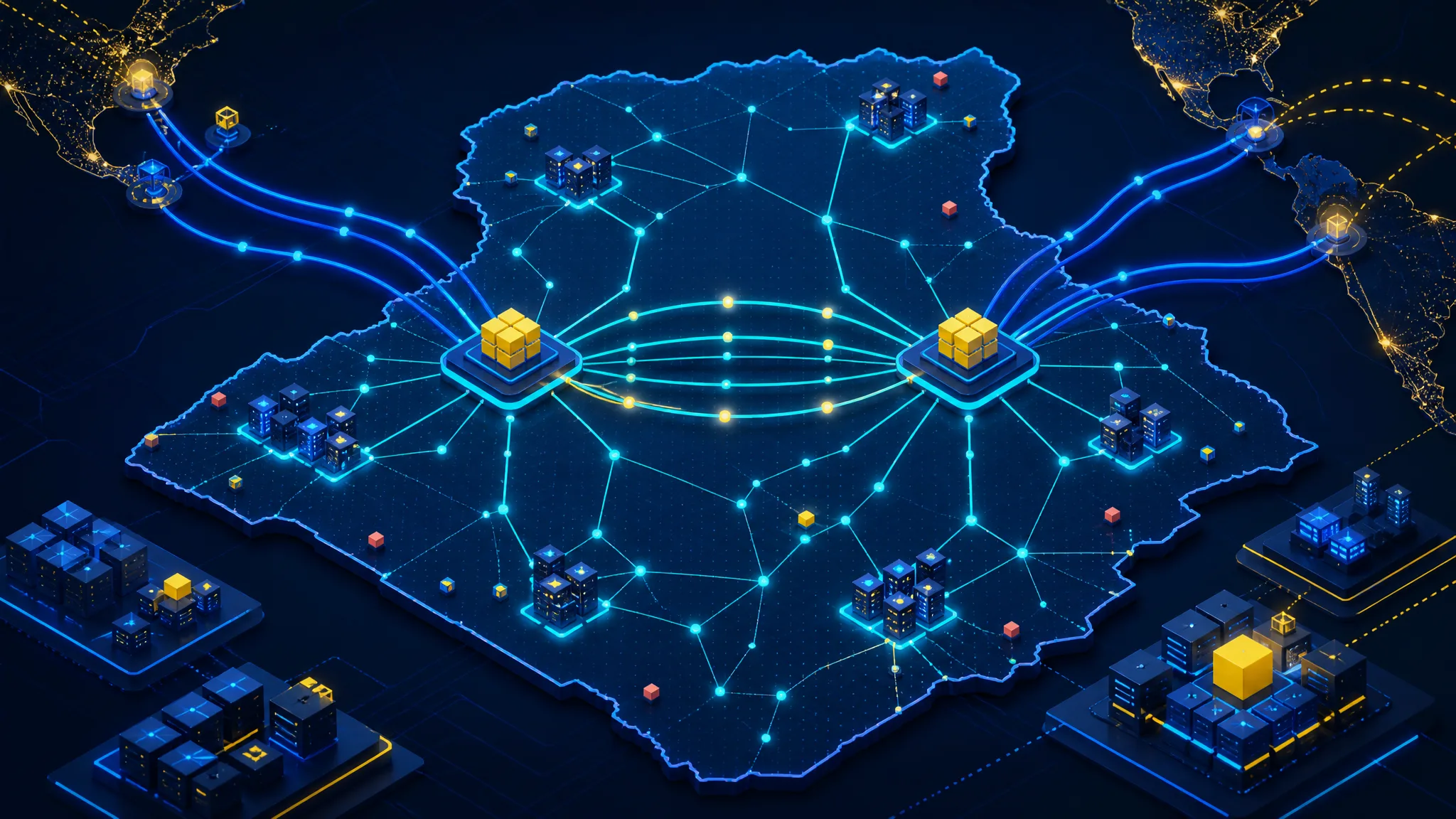
Imagine two Algerian networks exchanging traffic while their packets travel through an overseas transit provider first. The detour may add delay, consume international capacity and expose a domestic service to a problem beyond Algeria’s borders. An Internet exchange point, or IXP, is designed to remove that unnecessary step. Yet an IXP is not a magic shield. Its resilience value depends on who connects to it, where it operates, which services are available locally and whether the rest of the national network can keep carrying traffic when something breaks.
When a person in Algiers opens a service hosted in Algeria, it is tempting to assume the request will remain inside the country. Internet routing does not work that way automatically. Two networks can sit close to each other geographically and still exchange traffic through an overseas provider because they lack a direct local arrangement.
That detour creates more than a slower connection. It uses international capacity, adds another organisation to the path and exposes a domestic exchange to failures outside Algeria. A submarine-cable incident, a transit-provider outage or a change in routing can affect traffic that never needed to leave the country.
An Internet Exchange Point, or IXP, addresses this specific gap. It gives different networks a shared place to connect and exchange traffic directly through peering. The participants might include fixed-line providers, mobile operators, cloud and hosting companies, content-delivery networks, public institutions and large enterprise networks.
The case for an Algerian IXP is therefore conditional. It could make domestic traffic more local and reduce the blast radius of some international failures. But it would not make Algeria independent from the rest of the Internet. Its usefulness would depend on the infrastructure and community built around it.
An IXP Is a Local Meeting Point for Networks
The simplest way to understand an IXP is to picture a shared junction rather than a single Internet provider. Each participating network brings its own connection and equipment to the facility. The IXP supplies a common switching environment through which those networks can establish direct exchanges.
Peering is the technical and commercial relationship that makes those exchanges possible. Instead of paying an upstream provider to carry traffic between two networks, the networks can agree to exchange some traffic directly. The IXP does not become the owner of every packet or replace the participating providers. It creates a neutral place where their networks can meet.
That neutrality matters. Competing providers are more likely to connect to a facility they can trust, with clear rules and equal technical conditions. A successful exchange therefore needs more than a powerful switch. It needs governance that participants accept, operators who can maintain the platform and a community willing to peer actively.
A domestic IXP would not keep all Algerian Internet traffic in Algeria. A request for a service hosted in another country still needs international connectivity. Nor would every participant automatically exchange traffic with every other participant. Routing policies, commercial agreements and the location of content would continue to shape the path.
The narrower promise is also the more credible one: an IXP can provide a local path for traffic that is eligible for local exchange and involves networks connected to the facility. That distinction prevents a common mistake. “Local IXP” does not mean “all traffic becomes local.”
An IXP, in plain English
An IXP is a shared technical meeting point where separate networks exchange traffic directly instead of sending every local request through an international transit provider.
What Local Peering Could Change
Consider a customer on an Algerian mobile network accessing an application hosted in an Algerian data centre. If the mobile operator and the hosting network peer locally, the request and response may use a domestic route. If they do not, the traffic may be sent to an international transit provider before returning to Algeria.
A local route can reduce latency, which is the time taken for data to travel and for a response to come back. The difference matters most for interactive services: video calls, online games, remote work tools, financial applications and systems that exchange many small requests.
Latency is not the same as overall connection speed. A long route can still support a large download, while a short route can perform badly if it is congested. Local peering can nevertheless remove unnecessary distance and intermediate networks. It can also free some international capacity for traffic that genuinely needs to travel abroad.
There is a financial dimension as well. International transit is a paid service. Direct domestic exchange can reduce some transit requirements, although the final business case depends on connection costs, traffic volumes, operating arrangements and the agreements between networks. An IXP is not automatically cheaper for every participant.
Local exchange can also make Algeria more attractive to content-delivery networks, or CDNs. A CDN stores copies of frequently requested content closer to users. If a CDN places a cache in a local data centre and connects it to the exchange, some video, software, images or web content can continue to be served locally even when an international path is impaired.
That benefit has a clear boundary. A cache cannot contain every service, every account transaction or every live data source. A platform whose origin server, authentication system or critical database remains abroad may still fail when international connectivity is interrupted. Local delivery improves the availability of selected content, not the entire online experience.
The same logic applies to public and commercial services. Government portals, banking systems, education platforms and business applications become more resilient when their important components are hosted locally and connected through diverse domestic routes. An IXP can help those components communicate efficiently, but it cannot create the hosting capacity by itself.
Two routes for one local request
Without local peering, traffic between two Algerian networks may depend on an external transit path, even when both endpoints are in Algeria.
With local peering, eligible traffic can move directly between participating networks. The shorter route helps only when those networks, and the requested content, are actually connected locally.
Algeria Needs a Measured View of Its IXP Landscape
Before deciding what an IXP would solve, policymakers and operators need a reliable picture of what already exists. Public IXP data is useful, but it must be read as a measurement system rather than an exhaustive inventory of every private connection.
Internet Society Pulse says its IXP Tracker uses member information from PeeringDB. That information is reported by IXP operators and networks, and the tracker is refreshed monthly. The data can therefore help establish whether an exchange is publicly documented, who appears to participate and how the public record changes over time.
It cannot prove that no private bilateral interconnection exists. Two networks may exchange traffic through an arrangement that is not represented in the public dataset. A lack of a visible entry may indicate limited public interconnection, incomplete reporting or an exchange that does not fit the tracker’s measurement scope.
This caveat is not a technical footnote. It changes the way Algeria’s situation should be described. A public data gap should not become a sweeping claim that all domestic traffic leaves the country. It is better treated as a reason to verify the current landscape directly and improve its visibility.
That verification could combine public registry data, operator disclosures, route measurements and traffic studies. It should ask practical questions: which networks peer, which routes are used, which services are hosted locally and what happens when a particular international path disappears?
Algeria’s large and growing demand for Internet access makes these questions more consequential, but demand alone does not create a useful IXP. An exchange needs enough traffic and enough diversity to justify participation. A platform that connects only a few networks, or offers no important local content, may exist without changing many user experiences.
The first policy goal should therefore be visibility. Algeria needs to know where local exchange already happens, where it fails to happen and which dependencies force domestic traffic onto international routes. That evidence would make future investment more precise.
An IXP creates an opportunity for local exchange. Resilience comes from the wider ecosystem: participants, routes, sites, power, hosting and content.
Resilience Depends on the Ecosystem Around the Switch
There is a difference between making local delivery faster and making it survive an outage. The first may require one working connection between two networks. The second requires alternatives when a facility, route, provider or utility becomes unavailable.
The number of connected networks is an important starting point. Fixed and mobile operators bring access users. Hosting providers bring servers and applications. CDNs bring cached content. Cloud platforms, universities, public services and enterprise networks add further destinations. The more relevant networks peer, the more likely a local route exists for a given exchange.
Participation also needs density. An IXP with many members can still provide little resilience if those members connect only occasionally or exchange very little traffic. Active peering creates a web of usable paths. The benefit is not the membership list; it is the traffic that can actually move across those paths.
Governance is part of the engineering. Operators that compete in the retail market must still cooperate at the interconnection layer. They need clear access rules, predictable technical standards, transparent fees and a process for resolving disputes. Neutral governance helps prevent the exchange from becoming an extension of one participant’s commercial network.
The facility itself needs dependable conditions. Routers and servers require power, cooling, physical security, monitoring, spare capacity and skilled technical staff. Maintenance must be planned without taking down the whole platform. Security controls must protect the exchange without making legitimate operational work impossible.
Location matters just as much. Two exchange rooms in the same building are not two independent sites if they share the same power feed, fibre entrance, cooling plant or flood risk. Genuine geographic redundancy means that a local incident at one site does not remove every path to the exchange.
Transport routes require the same scrutiny. Several logical connections can run through one physical duct. Several providers can rely on the same metropolitan fibre corridor. Diversity is real only when the underlying routes, buildings and network equipment are independent enough to fail separately.
These requirements make an IXP a community and infrastructure project, not a procurement exercise. The platform is necessary. It is not sufficient.
A capacity milestone, not a resilience guarantee
Algeria’s Ministry of Post and Telecommunications reported 9.8 Tbps of equipped international bandwidth capacity in 2024. That figure shows scale, not how much traffic could remain local during a failure.
SourceThe Outage Test Is More Useful Than the Speed Test
A new exchange will attract attention through latency measurements and traffic volumes. Those indicators matter, but they do not answer the central resilience question: what remains available when something breaks?
A practical test begins by mapping routes between Algerian access networks and important destinations. Measurement probes placed in several cities can observe whether traffic stays inside the country, leaves and returns, or changes path after a disruption. Repeating the measurements over time matters because a route seen once may not be the route used during congestion or maintenance.
The test should cover more than popular websites. It should include public services, locally hosted applications, business platforms, mobile and fixed networks, CDN caches and services whose core infrastructure remains abroad. Different destinations have different dependencies, so a single “national Internet” score would hide useful distinctions.
Engineers should then model several failures:
- an international transit provider becomes unavailable;
- a submarine route loses capacity;
- the main IXP site loses power or connectivity;
- a domestic fibre corridor is cut;
- a local data centre or CDN cache goes offline.
For each event, the questions are concrete. Does traffic find another local path? Does it move to a second exchange site? How much content remains available from local caches? Which applications fail because their authentication, storage or origin servers are overseas?
Regional measurement tools such as RIPE NCC’s Region Meshes offer a useful model for comparing paths between networks and observing changes over time. Algeria could build a similar operational dashboard around its own priorities. The point would not be to publish a reassuring number. It would be to reveal dependencies before an incident exposes them.
After an outage, the same measurements could show whether routes recovered, whether recovery used a genuinely different path and how long the change lasted. That evidence would distinguish resilience from temporary availability.
One further distinction is essential. An IXP may keep a local exchange running while users still experience an outage because the application depends on an unreachable overseas service. Local routing is one layer of resilience. Application architecture, hosting, DNS, authentication and data storage add others.
Questions for any IXP proposal
The useful evaluation starts with the network around the exchange, not the equipment list.
- Which fixed and mobile operators will peer actively?
- Are sites, power systems and fibre routes genuinely independent?
- Which public, commercial and content services are available locally?
An IXP Cannot Replace Cables or a National Backbone
Algeria’s resilience architecture has two directions to strengthen: inward and outward. The inward layer includes domestic transport, national fibre routes, data centres, energy systems and local interconnection. The outward layer includes submarine cables, international gateways, transit providers and the capacity to reach the rest of the world.
The Ministry of Post and Telecommunications describes resilience in similarly complementary terms. Its priorities include diversifying submarine links and international access points while strengthening national transport networks, domestic transmission routes and redundancy for energy, routing nodes and transmission links.
This matters because an IXP cannot repair a cable. It cannot increase international capacity by itself. It cannot make a foreign cloud region reachable when every external path is down. If a service is hosted abroad and has no local cache or alternative architecture, it remains dependent on international connectivity.
Algeria’s ministry reported 9.8 Tbps of equipped international bandwidth capacity in 2024, in the context of expanding and diversifying submarine links. That is a significant capacity reference, but it does not tell us how traffic behaves during a failure. Capacity and resilience overlap, yet they are not interchangeable.
A country can have substantial international bandwidth and still suffer a large outage if the capacity is concentrated on common routes. Conversely, local exchange can protect some domestic services while international users and overseas platforms remain affected. The right investment question is not “local or international?” It is “which dependency should this investment reduce?”
National backhaul deserves the same attention. If all routes from a secondary city converge on one fibre corridor or one metropolitan facility, an IXP in the capital cannot provide national resilience on its own. Local exchange must be reachable through diverse domestic paths, or the benefits will remain concentrated near the facility.
Data-centre quality and energy autonomy are equally practical. Local hosting is useful only when servers remain powered, cooled, connected and operated during an incident. Backup generators and batteries help, but resilience also depends on fuel, maintenance, replacement parts, physical access and tested procedures.
The most credible strategy would connect these layers. Stronger domestic transport would feed multiple exchange sites. Reliable local hosting would give peering something valuable to carry. CDN deployment would keep selected content nearby. Diverse submarine routes would preserve access to services that cannot be localised.
What an IXP cannot repair
An IXP cannot restore a damaged submarine cable, create an overseas service locally or compensate for a weak national backbone, unstable power or poor data-centre operations.
Conclusion: An IXP Is a Conditional Resilience Investment
Could an Internet exchange point improve the resilience of Algeria’s domestic traffic? Yes, under the right conditions. It could keep eligible exchanges between Algerian networks inside the country, reduce unnecessary international transit and limit the effects of some external failures.
That is a narrower claim than “an IXP will make the Internet faster” or “an IXP will protect Algeria from outages.” It is also more useful. The value lies in reducing particular dependencies, not in promising universal continuity.
The decisive checklist is practical. Are the major fixed and mobile networks connected and actively peering? Are local public, commercial and content services present? Are there multiple geographically separated sites? Do fibre routes, power systems and data centres fail independently? Can traffic reach the exchange through a diverse national backbone?
There is a second checklist beyond the exchange. Are Algeria’s submarine routes diversified? Is international capacity distributed across independent paths? Can operators coordinate during an incident? Are route measurements collected before, during and after failures?
If the answer to those questions is no, a new IXP may still improve ordinary local delivery, but its outage-resilience promise will be limited. If the answers are yes, the exchange can become a missing layer in a broader architecture that combines local peering, hosting, CDN caches, domestic transport and international diversity.
The right ambition is not to keep all of Algeria’s Internet inside Algeria. That would be neither possible nor desirable. It is to ensure that traffic which can remain local does not depend unnecessarily on a distant transit path, while traffic that must travel internationally has more than one way to do so.
That is how an IXP could reduce the blast radius of a failure. Not by replacing the cables, backbone or data centres, but by making the whole system less dependent on any one of them.
Sources
- Explainer: What is an Internet Exchange Point (IXP)? — Internet Society
- How Governments Can Reduce the Impact of Internet Outages — Internet Society Pulse
- IXP Tracker — Internet Society Pulse
- Security and resilience of telecommunications infrastructures — Ministry of Post and Telecommunications
- Evolution de la bande passante internationale — Ministry of Post and Telecommunications
- Community-Driven IXPs Enhancing Local Connectivity and Sustainability — Internet Society
Daymain Team