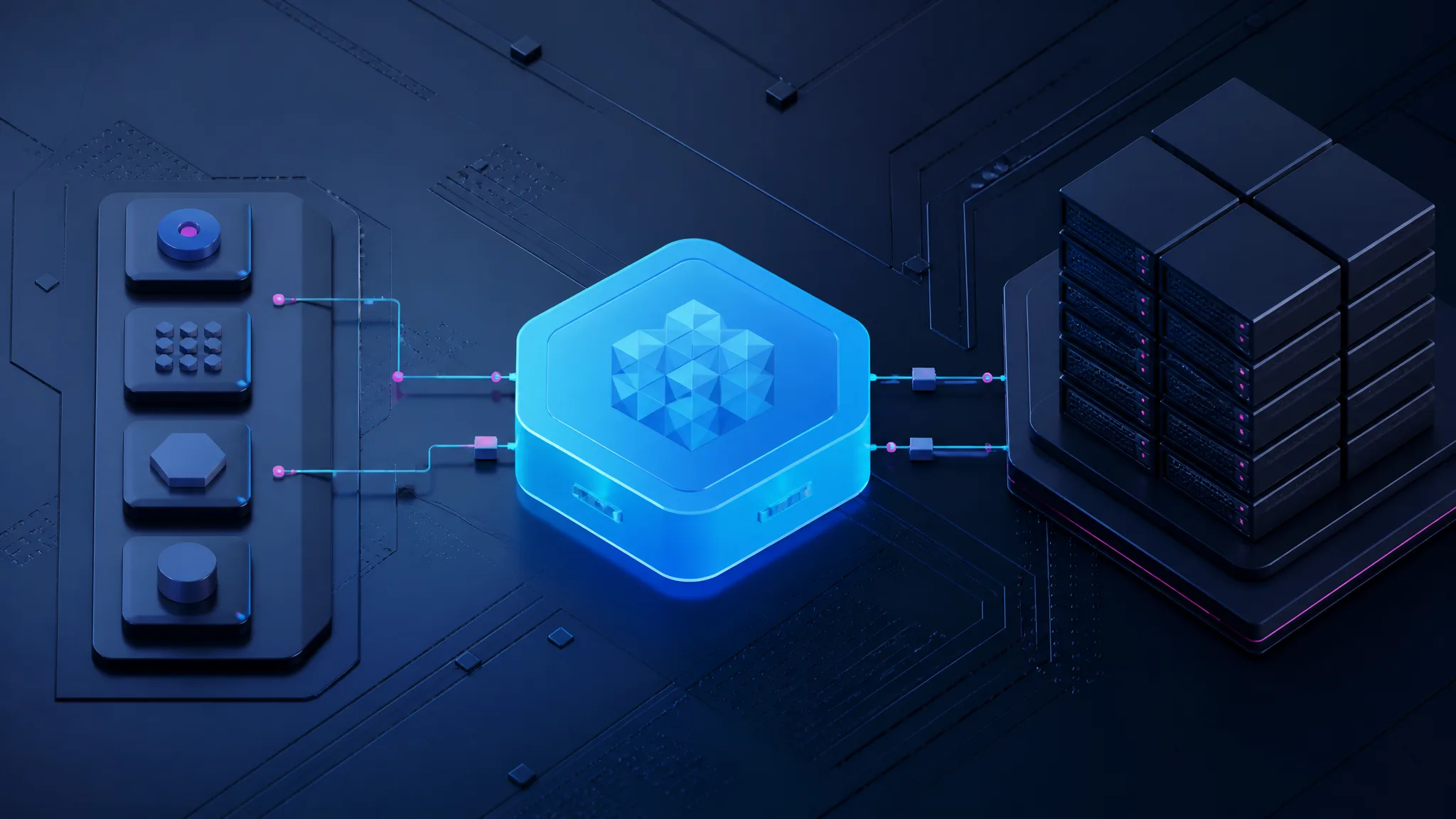
A small transformation function can end up carrying an entire application environment with it: an image, a base system, libraries, startup logic and a long list of permissions. That packaging is often useful. But sometimes the code needs far less. Server-side WebAssembly asks whether the deployment unit can be reduced to the module itself, with access to files, networks or other resources granted deliberately. WASI makes that model practical. It also exposes a harder question: where does a smaller runtime genuinely help, and where does a full Linux environment remain the more honest choice?
A small transformation function can end up carrying an entire application environment with it: an image, a base system, libraries, startup logic and a long list of permissions. That packaging is often useful. But sometimes the code needs far less.
Server-side WebAssembly asks whether the deployment unit can be reduced to the module itself, with access to files, networks or other resources granted deliberately. WASI makes that model practical. It also exposes a harder question: where does a smaller runtime genuinely help, and where does a full Linux environment remain the more honest choice?
The real comparison is smaller execution unit versus general-purpose environment
WebAssembly and containers are often placed in a race for the next default server platform. That framing is too broad to help with an architecture decision.
A container packages an application with the environment it expects to run in. It does not contain a separate kernel, but it gives the process a boundary around filesystem, process, network and other operating-system resources. In practice, that makes containers a convenient way to distribute applications built for Linux.
Container workflows also come with a large operational advantage. Teams know how to build images, scan them, store them in registries, deploy them through orchestrators and connect them to logging, metrics and networking systems. That familiarity is not a minor detail. It lowers the cost of running a system after launch.
WebAssembly begins from a different abstraction. It is a portable binary format and execution target, designed to run code with a defined machine model. Outside the browser, the host runtime decides how that code can interact with the surrounding system.
WASI, short for WebAssembly System Interface, supplies standardized interfaces for those interactions. Depending on the implementation and configuration, a module can work with resources such as files, clocks, randomness, sockets or other host-provided services.
The important distinction is therefore not “WebAssembly versus Docker” in the abstract. It is a choice between a deliberately narrow execution unit and a more general application environment.
A request handler that parses a document, a rule engine that evaluates a policy or a plugin that transforms data may need only a few interfaces. A database-backed service with native dependencies, background workers and a complex network may need much more. The technologies should be judged against those different shapes.
Do not ask whether WebAssembly will replace Docker. Ask what is the smallest execution unit this workload actually needs.
WASI makes access an explicit part of the contract
The central idea behind WASI is capability-oriented access. In this context, a capability is an authority to use a particular resource or interface. The host grants it; the module should not simply assume that the entire machine is available.
For example, an embedding application can expose a filesystem directory as a preopened resource, or provide network access through a specific host implementation. The module can use what the host makes available, but it does not automatically inherit every path, socket or operating-system service.
This changes the security boundary. With a conventional application, developers often start from a process that can call a broad set of operating-system APIs, then restrict it through deployment configuration. With WASI, the host can construct a smaller environment before the module runs.
That does not make WebAssembly code automatically safe. A runtime still has to enforce the boundary correctly. The host must configure interfaces carefully, limit CPU and memory where appropriate, and treat the module and its dependencies as software that requires review.
Wasmtime’s WASI Preview 2 documentation makes the model concrete. The runtime exposes particular interfaces for resources, while the embedding application determines which of those interfaces and resources are available. The module format alone does not decide the final permission set.
There is also a useful separation between memory and external resources. WebAssembly instances have their own linear memory, and communication with the outside world occurs through defined imports, exports and host interfaces. A plugin can therefore be given a narrower contract than an ordinary library loaded into the same process.
For platform teams, the practical work starts with an inventory. What does the code read? What does it write? Does it need DNS, outbound HTTP, a clock, randomness, environment variables or secrets? Which WASI interface supplies each requirement, and does the target runtime implement it consistently?
That checklist is more valuable than asking whether a language “supports WebAssembly.” Compilation is only the first step. A usable deployment also needs the right interfaces, a suitable runtime and a stable contract between the host and the guest code.
Two different boundaries
WASI gives a module selected interfaces and capabilities through its host. The module does not receive a complete operating system by implication.
A container usually offers an environment much closer to Linux, with broader compatibility for existing libraries, tools, networking patterns and operational workflows.
Plugins show why a narrow boundary can be useful
One of the strongest cases for server-side WebAssembly is code that should run inside a platform without receiving the platform’s full trust.
Consider a document service that allows customers or partner teams to install transformation plugins. A plugin might need the document as input and permission to return a modified document. It probably does not need to browse the host filesystem, contact arbitrary internet endpoints or read application credentials.
The host can expose those inputs and outputs through a small interface. It can withhold filesystem and network capabilities unless a specific plugin genuinely needs them. The result is not perfect security by itself, but it is a clearer and more enforceable contract than loading an unrestricted library into the application process.
The same pattern can apply to policy rules, data filters, user-defined expressions and extensions for developer tools. In each case, the code is useful precisely because it performs a focused operation. The platform benefits when that focus is reflected in the runtime boundary.
A container can also run untrusted or semi-trusted workloads with hardening, namespaces, resource limits and other controls. The comparison is not between secure WebAssembly and insecure containers. It is between two ways of expressing and operating an isolation boundary.
Containers generally start with a broader environment. That is helpful when software expects Linux conventions, native libraries or command-line tools. It can be unnecessary when the required contract is only “receive these bytes, compute a result and return it.”
Capability control also helps with portability. If the host offers the same logical interface in different environments, the module can move without embedding every deployment decision inside the code. The portability is not absolute, however. A module remains dependent on the interfaces it uses and on how those interfaces behave in each runtime.
For untrusted plugins, teams still need validation, versioning, resource limits and monitoring. A narrow permission set reduces the consequences of mistakes, but it does not remove malicious logic, denial-of-service risks or bugs in the host integration.
A plugin with a narrow contract
A document plugin may need input bytes and permission to return transformed output, but no access to secrets, the host filesystem or outbound networking. WASI lets the host build around that smaller contract.
Startup and footprint are promising, but the runtime decides the result
WebAssembly’s server-side appeal often begins with a simple intuition: a small module should need less preparation than a complete application environment. That can be true, particularly for short-lived functions, but the size of the module is not the whole startup story.
A runtime still has to load the module, validate it, allocate memory and connect it to the host. The host may also need to initialize adapters, credentials, network clients or other services. If the module is wrapped in several layers of orchestration, those layers can dominate the time saved by a smaller binary.
Recent research supports a qualified performance case. A 2025 study of WebAssembly in serverless edge-cloud workloads reported images up to 30 times smaller than container images and cold starts up to 16% faster in its tested scenarios. Those results describe a particular experimental setup, not a universal property of every Wasm deployment.
The same study found that execution mode matters. Ahead-of-time-compiled Wasm performed much more favorably than interpreted Wasm for the workloads examined, while interpreted execution showed substantially higher warm latency and I/O serialization overhead.
This distinction is easy to miss when WebAssembly is discussed as a single technology. A module running through a compact, optimized runtime is not equivalent to the same code running through a slower interpreter or an integration with expensive host calls.
Workload shape matters just as much. A function called rarely may be dominated by initialization. A function kept warm may spend most of its time waiting for a database or remote API. A CPU-heavy transformation may benefit from efficient compiled execution, while a file-heavy task may run into the cost of crossing the host boundary repeatedly.
That is why a benchmark should measure the full request path. Include module loading, host setup, memory use, input and output transfer, external I/O and repeated invocations. Compare the actual runtime and deployment mode rather than comparing a Wasm file with an unoptimized container image.
Footprint deserves the same care. A small artifact can run inside a runtime that consumes significant memory. Conversely, a container platform may already keep its common runtime and infrastructure warm. The relevant figure is the cost of the deployed system per instance and per request, not the compressed size printed in a build report.
WebAssembly is most convincing when the workload is small enough to keep the host contract simple and frequent enough for the operational savings to matter. It is less convincing when the application needs a large dependency tree or spends most of its time outside the module.
The performance range is conditional
A 2025 study reported Wasm images up to 30 times smaller and cold starts up to 16% faster than containers in tested workloads. It also found major warm-latency and I/O penalties for interpreted Wasm.
SourceRuntime choice and host calls can change the performance profile
WebAssembly is a format, not a single server engine. The runtime determines how modules are compiled, cached, scheduled, limited and connected to resources.
Wasmtime can run as a standalone runtime or be embedded as a library inside another application. That gives platform developers control over the lifecycle of modules and the interfaces exposed to them. It also means that teams must make more decisions than they would when deploying a conventional process.
A standalone runtime may suit a focused command or service. An embedded runtime may suit a gateway, plugin host or policy engine that needs to load many modules while keeping ownership of authentication, quotas and request handling.
Different runtimes can also produce different memory and startup results. A 2025 IEEE study of WebAssembly runtimes integrated with Kubernetes reported that its WAMR integration reduced memory use by 11% to 78% compared with existing Wasm runtimes in the tested configurations. It also outperformed four of six tested runtimes in startup time.
Those findings reinforce a practical rule: do not select WebAssembly and stop there. Select a runtime, an execution mode and an integration model. Then test them against the exact workload and limits that matter in production.
Host calls deserve particular attention. Reading a file, opening a socket or invoking a host function can cross a boundary between guest code and the runtime. A workload that makes thousands of small calls may behave very differently from one that exchanges larger, less frequent batches.
This is one reason a focused transformation can be a better Wasm candidate than a general application. The module can perform most of its work locally, then use a small number of clearly defined host interfaces. The fewer and simpler the crossings, the easier it is to reason about both performance and permissions.
Day-two operations are where containers still have a deep advantage
A runtime that starts quickly is not automatically a runtime that is easy to operate. Production teams need to identify versions, inspect failures, correlate requests, enforce quotas and understand what happened after an incident.
WebAssembly does not replace those operational requirements. The host has to provide logging, metrics, tracing, request identifiers, health checks and lifecycle management. It also needs a way to report whether a failure came from the module, the runtime or a host interface.
Wasmtime’s profiling documentation points in a useful direction by separating time spent in WebAssembly code, the Wasmtime host and potentially the kernel. That distinction can help an engineer test whether a slow request is caused by guest computation, runtime work or a system operation.
Profiling is not the same as observability, though. Teams still need conventions for collecting and retaining signals across instances. If a module is loaded by a gateway, a function platform or an application process, the surrounding host must carry those signals into the organization’s existing tooling.
Containers start with a stronger operational ecosystem. Most infrastructure teams already have established patterns for image promotion, vulnerability scanning, service discovery, resource limits, rollbacks and incident response. Those patterns are imperfect, but they are understood and widely supported.
This installed base can outweigh a theoretical reduction in startup time. Introducing a new Wasm runtime may require new build pipelines, new dashboards, new debugging habits and new security reviews. The cost is justified when the workload gains something meaningful from the smaller boundary. It is harder to justify for an ordinary web service that already fits comfortably into the container platform.
There is a further maturity question around packaging. Docker documents a containerd-based workflow for Wasm workloads, which can make experimentation feel familiar. But its Docker Desktop integration is labelled beta and documented as deprecated. A convenient wrapper is not necessarily a durable production strategy.
The lesson is not that Wasm cannot be operated seriously. It is that the complete operating path matters. A portable module can still depend on a runtime, adapter, image format, orchestration layer and observability stack that are changing at different speeds.
A familiar wrapper can still be immature
Docker documents its Wasm workflow as beta and says the Docker Desktop integration is deprecated. The runtime and operating model matter as much as the module format.
Resource access and standard maturity set the practical boundary
WASI becomes a credible alternative when an application can describe its needs as a small, stable set of interfaces. The case weakens as the application expects a broad Linux environment.
Full applications often depend on native libraries, shell tools, process behavior, detailed filesystem semantics, complex network configuration or specialized devices. Reproducing all of that through a portable WebAssembly interface may be possible in some cases, but it can erase the simplicity that made Wasm attractive.
Stateful systems present a similar challenge. WebAssembly can participate in a stateful service, but the module itself is not a replacement for a database, durable volume or mature storage system. If the workload’s main complexity sits in state management, a small execution unit may not simplify the architecture very much.
Standards are progressing, but progress is not the same as universal compatibility. The WASI project describes Preview 2 as stable, and WASI 0.3, launched in June 2026, adds native asynchronous primitives to the Component Model. At the same time, the broader Component Model ecosystem is still moving toward a future 1.0 milestone.
That combination matters. Teams can build useful systems today, especially around interfaces that their chosen runtime supports well. They should not assume that every proposed interface, language binding or component workflow has the same stability.
Asynchronous support is particularly relevant for servers. Real services wait on networks, storage and other external systems. Native async primitives can make those interactions more natural, but the practical result still depends on host implementations, language tooling and the way components are composed.
Before adopting WASI for a critical path, verify the exact interface matrix. Confirm filesystem behavior, networking support, asynchronous execution, language bindings, debugging tools and version compatibility. A successful demonstration proves that a path exists. It does not prove that the path is stable, portable or easy to maintain.
Containers remain the safer default when the requirement is “run this existing Linux application with its known dependencies.” WASI is a stronger candidate when the requirement is “run this narrowly defined computation with only these explicitly granted resources.”
A four-test framework for choosing between WASI and containers
A technology decision becomes clearer when it is tested against the workload rather than against a feature checklist. Four questions usually reveal the boundary.
1. Can the capability contract stay narrow?
List every external resource the code needs. If the list is short and understandable, WASI can turn that list into a meaningful host contract. If the code expects broad filesystem access, arbitrary networking and many system services, the advantage of capability restriction becomes less distinct.
2. Does startup or density matter enough to justify a new runtime?
Measure cold starts, warm latency, memory per instance and the cost of host calls. Small functions and bursty edge workloads may gain from lower initialization overhead. Long-running services may gain little if startup is a small fraction of total work.
3. Can the team operate the complete path?
Include builds, signing or verification, distribution, runtime upgrades, logging, profiling, rollback and incident response. A technically efficient module can still be a poor platform choice if nobody can diagnose it at the required hour.
4. Are the interfaces mature enough for the consequences?
Check the runtime’s support for the exact WASI and Component Model features in use. A prototype can tolerate an evolving interface more easily than a payment path, customer data service or long-lived internal platform.
These tests usually produce a mixed answer. A company may use containers for its main services, then host customer plugins or edge transformations in WebAssembly. That is not an indecisive architecture. It is a recognition that different workloads benefit from different boundaries.
Conclusion: use WASI when the workload can stay small
Server-side WebAssembly does not need to replace containers to earn a place in production. Its strongest case is narrower: short functions, portable command-line tools, edge services, policy engines and plugins that should operate under a deliberate set of permissions.
WASI gives the host a way to express those permissions through interfaces and capabilities. WebAssembly provides a portable execution target with isolated module memory. Together, they can reduce the amount of environment a small unit needs and make its relationship with the host easier to describe.
The benefits are conditional. Ahead-of-time compilation can produce small artifacts and competitive cold starts, while interpreted execution or chatty I/O can change the result sharply. Runtime implementation, host calls, memory reuse and orchestration all affect the final profile.
Containers remain the more straightforward choice for full Linux applications, complex networking, stateful systems, extensive native dependencies and teams that already rely on mature container operations. Their generality is often a feature, not waste.
The best decision therefore starts with a boundary question: what is the smallest execution unit that can do the job without fighting its environment?
If the answer is a focused module with a few stable capabilities, WASI deserves a measured production trial. If the answer is an application that expects the operating system around it, a container is probably the more dependable envelope. The future is likely to contain both—not because every technology must coexist, but because the workloads are not all the same.
Sources
- Specifications — WebAssembly.org
- WASI 0.3 Launched — Bytecode Alliance
- Module p2 — Bytecode Alliance
- Lumos: Performance Characterization of WebAssembly as a Serverless Runtime in the Edge-Cloud Continuum — Cynthia Marcelino, Noah Krennmair, Thomas Pusztai, Stefan Nastic
- Memory Efficient WebAssembly Containers — Matthijs Jansen, Maciej Kozub, Alexandru Iosup, Daniele Bonetta
- Wasm workloads — Docker
- The Road to Component Model 1.0 — Bytecode Alliance
Daymain Team